Misją Instytutu jest dzialalność naukowo-badawcza prowadząca do nowych rozwiązań technicznych i organizacyjnych użytecznych w kształtowaniu warunków pracy zgodnych z zasadami bezpieczeństwa pracy i ergonomii oraz ustalanie podstaw naukowych do właściwego ukierunkowywania polityki społeczno-ekonomicznej państwa w tym zakresie.
Knowledge base search


COLLECTIVE PROTECTIVE MEASURES
Collective protection measures against bioaerosols include, among others, general mechanical ventilation systems and local mechanical ventilation installations equipped with air filters.
Efficient ventilation not only improves the condition and composition of the air in rooms, but also regulates the parameters of the indoor environment such as: temperature, humidity, air speed and direction, as well as concentration of pollutants.
In industrial premises, where significant amounts of organic dust are emitted at individual workstations, the most beneficial solution is to hermetize the technological processes. For this purpose, airtight (either complete or partial) enclosures of the pollutant emission area are used. It is also recommended to use a local ventilation installation equipped with suction nozzles or hoods, connected to a dust removal system or a filtration and ventilation device.
Various filtration systems are used to clean the air, depending on the required degree of purity of the air supplied or extracted from the premises by ventilation systems or installations. Due to the high requirements for air purity, multi-stage filtration systems are used.
TECHNICAL MEASURES
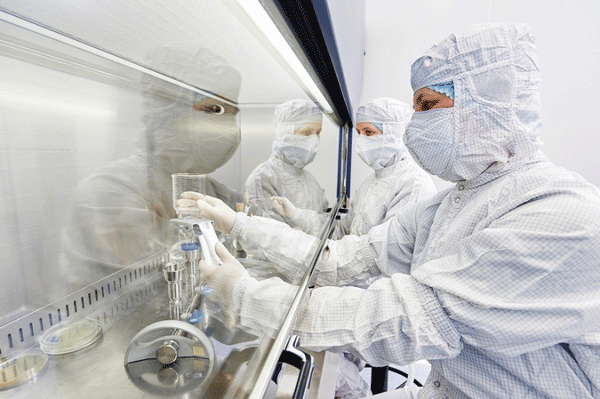
Technical measures shall effectively eliminate or reduce threats at source. They mainly consist of automation and mechanization of work processes. Safe work with harmful biological agents begins at the planning stage of the workplace, when all necessary changes related to their later use can be made. The following should be taken into account: the number of people working at a specific workplace, the number and size of premises (including additional rooms designated for scullery, laboratory air locks, toilets), the equipment that employees will use and the technical requirements for floors, walls and ceilings, media connections and ventilation devices, as well as requirements for sun and fire protection. Directive 2000/54/EC of the European Parliament and of the Council of 18 September 2000 on the protection of workers from risks related to exposure to biological agents at work (Official Journal L 262, 17/10/2000 P. 0021 - 0045) obliges the employer to use appropriate containment measures adapted to protect employees from biological agents in the following places: laboratories, including diagnostic laboratories, and rooms for laboratory animals, which have been deliberately infected with biological agents from group 2, 3, or 4 or are suspected to be carriers of such agents. .
Containment measures are also determined for industrial processes. Containment levels determines the employer's protective measures (containment measures) preventing or reducing the accidental transfer or release of a biological agent outside the workplace. Containment measures for laboratories are presented in Annex V to the Directive 2000/54/EC (Official Journal L 262, 17/10/2000 P. 0021 - 0045).
When working with harmful biological factors from hazard group 1 (including attenuated vaccines), preventive measures specified in the regulations on occupational health and safety and the principles of good laboratory practice should be applied. Activities involving the handling of a biological agent must be carried out:
- only in working areas corresponding to at least containment level 2, for a group 2 biological agent,
- only in working areas corresponding to at least containment level 3, for a group 3 biological agent,
- only in working areas corresponding to at least containment level 4, for a group 4 biological agent.
If there are activities with multiple agents, the agent belonging to the highest hazard group determines the assignment to the containment level. In the case of activities performed with the unintentional use of a biological agent, assignment to individual containment levels is made depending on the level of infectious threat that a given agent may cause, taking into account the hazard group, the probability of the agent occurrence and the probability of the threat occurrence. Activities that increase the level of infectious threat include, for example, those during which an aerosol (dust) may be created, manual activities with a high risk of injury, work that may be accompanied by the presence of agents with a low infectious dose or belonging to a high hazard group. Allergenic and toxic activities do not affect the assignment to the hermeticity level, but require appropriate protective measures.
|
GDPR clause Digital accessibility Copyright © Central Institute for Labour Protection - National Research Institute All rights to the works made available are reserved, with the exception of works made available under open access terms. As of August 1st, 2026, the open access provision referred to in the preceding sentence is subject to the Creative Commons CC-BY NC 4.0 license. All licenses previously granted under the Creative Commons CC-BY ND 4.0 license remain in effect. Copying parts or the entirety of other materials not covered by Creative Commons licenses is permitted solely for personal use. |
 |